
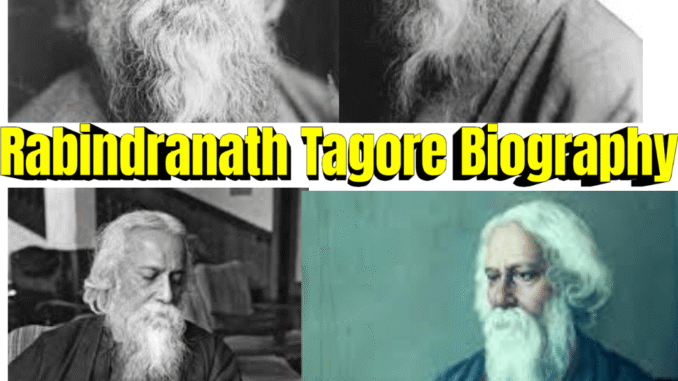
The Rabindranath Tagore biography tells the inspiring story of one of India’s greatest literary figures, philosophers, and cultural reformers. Rabindranath Tagore was a poet, novelist, playwright, composer, and painter who reshaped Bengali literature and music in the late 19th and early 20th centuries. He became the first non-European to win the Nobel Prize in Literature in 1913, bringing global recognition to Indian literature.
Tagore’s works continue to influence writers, artists, educators, and thinkers around the world. His life was marked by creativity, intellectual curiosity, and a deep love for humanity.
Rabindranath Tagore Biography
| Field | Details |
|---|---|
| Full Name | Rabindranath Tagore |
| Date of Birth | May 7, 1861 |
| Place of Birth | Kolkata (Calcutta), British India |
| Nationality | Indian |
| Profession | Poet, Writer, Philosopher, Composer |
| Nobel Prize | Literature (1913) |
| Famous Work | Gitanjali |
| Date of Death | August 7, 1941 |
| Age at Death | 80 years |
Early Life and Family Background
Rabindranath Tagore was born on May 7, 1861, in Kolkata (then Calcutta), into a prominent Bengali family. His father, Debendranath Tagore, was a religious reformer and leader of the Brahmo Samaj movement, while his mother, Sarada Devi, managed the household.
Tagore grew up in a culturally rich environment filled with literature, music, and philosophical discussions. The Tagore family played a significant role in the Bengal Renaissance, a cultural movement that transformed Indian art and intellectual life.
Unlike most children of his time, Tagore disliked traditional classroom education. He preferred self-learning and was educated He preferred self-learning and was educated at home by tutors. This unconventional learning style allowed him to explore literature, music, and nature freely.
Education and Early Influences
In 1878, Tagore traveled to England to study law at University College London. However, he did not complete his formal degree. Instead, he immersed himself in English literature and Western music, broadening his creative horizons.
The blend of Eastern philosophy and Western thought greatly influenced his writing style. Upon returning to India, Tagore began publishing poems and essays that reflected both Indian traditions and global perspectives.
Literary Career and Major Works
The Rabindranath Tagore biography is inseparable from his vast literary contributions. He wrote:
- Over 2,000 songs
- Numerous poems
- Short stories
- Novels
- Gitanjali,”Gitanjali”,”poetry collection by Tagore”], is a collection of spiritual poems that earned him the Nobel Prize in Literature in 1913.
SoGora entiGhare-Bairety[“book”,”Ghare-Baire”,”novel byKabuliwalabook”,”Kabuliwala”,”short story by Tagore”]
His short stories were among the first in Bengali literature to portray realistic characters and social issues. He explored themes such as love, nationalism, spirituality, identity, and human relationships.
Nobel Prize Achievement
In 1913, Rabindranath Tagore became the first Asian to win the Nobel Prize in Literature for Gitanjali. The award brought international attention to Indian literature and established Tagore as a global literary figure.
His Nobel Prize win was a historic milestone, proving that Indian writers could achieve global recognition.
Contribution to Music and National Anthems
Tagore was also a gifted composer. He created a unique style of music known as Rabindra Sangeet.
Remarkably, he wrote Jana Gana ManaJana Gana Mana”,”Amar Sonar Banglaar Bangla”,”national anthem of Bangladesh”]** – Bangladesh
This extraordinary achievement highlights his profound cultural impact.
Educational Reforms and Santiniketan
Tagore strongly believed in holistic education. In 1901, he founded a sVisva-Bharati Universityi University”,”public university in India”]**.
His educational philosophy emphasized:
- Learning in natural surroundings
- Creative freedom
- Integration of arts and academics
- Global cultural exchange
Santiniketan became a center for cultural and intellectual activity.
Philosophy and Political Views
Although Tagore supported India’s independence, he was critical of aggressive nationalism. He believed in universal humanism and harmonMahatma Gandhihatma Gandhi”,”Indian independence leader”]. While they respected each other, they sometimes differed in political views. Tagore gave Gandhi the title “Mahatma.”
Tagore renounced his British knighthood in 1919 in protest against the Jallianwala Bagh massacre, showing his moral courage and commitment to justice.
Personal Life
Rabindranath Tagore married Mrinalini Devi in 1883. The couple had five children. Unfortunately, Tagore faced several personal tragedies, including the deaths of his wife and children, which deeply influenced his later writings.
Despite personal sorrow, he continued to write and create, channeling his emotions into poetry and philosophy.
Later Years and Death
In his later years, Tagore traveled widely, delivering lectures across Europe, America, and Asia. He promoted cross-cultural understanding and global unity.
Rabindranath Tagore passed away on August 7, 1941, at the age of 80. His death marked the end of an era in Indian literature, but his legacy lives on.
Legacy and Influence
The Rabindranath Tagore biography reflects a life dedicated to art, education, and humanity. His influence extends across:
- Literature
- Music
- Education
- Philosophy
- National identity
He remains a central figure in Indian cultural history and global literature.
Conclusion
The Rabindranath Tagore biography tells the story of a visionary who transformed literature, music, and education in India and beyond. From winning the Nobel Prize to founding Visva-Bharati University, his contributions were groundbreaking.
Tagore’s poetry continues to inspire generations with its spiritual depth and universal message. His legacy as a writer, philosopher, and cultural icon remains timeless, ensuring that his influence will endure for centuries to come.
Frequently Asked Questions (FAQs)
1. Who was Rabindranath Tagore?
Rabindranath Tagore was an Indian poet, writer, and Nobel laureate known for Gitanjali.
2. When did Rabindranath Tagore win the Nobel Prize?
He won the Nobel Prize in Literature in 1913.
3. What is Rabindranath Tagore famous for?
He is famous for his poetry, novels, songs, and educational reforms.
4. Which national anthems did Tagore write?
He wrote India’s Jana Gana Mana and Bangladesh’s Amar Sonar Bangla.
5. Where was Rabindranath Tagore born?
He was born in Kolkata, India.
6. When did Rabindranath Tagore die?
He died on August 7, 1941.
Leave a Reply